[Skip to content](https://www.hubspot.com#main-content)
[](https://www.hubspot.com/startups?missing=undefined)
- [Resources](https://www.hubspot.com/startups/resources?missing=undefined) Show submenu for Resources
- [Fundraising](https://www.hubspot.com/startups/fundraising?missing=undefined)
- [Sales & Marketing](https://www.hubspot.com/startups/sales-and-marketing?missing=undefined)
- [AI Tech & Tips](https://www.hubspot.com/startups/ai?missing=undefined)
- [Tech Stack Guide](https://www.hubspot.com/startups/tech-stacks?missing=undefined)
- [Founder & VC Insights](https://www.hubspot.com/startups/scaling-smarter?missing=undefined)
- [Podcast](https://www.hubspot.com/startups/podcast?missing=undefined)
- [Stories](https://www.hubspot.com/startups/stories?missing=undefined) Show submenu for Stories
- [Digital Magazine](https://www.hubspot.com/startups/magazine?missing=undefined)
- [DocuSeries](https://www.hubspot.com/startups/docuseries?missing=undefined)
- [Case Studies](https://www.hubspot.com/startups/stories/customers?missing=undefined)
- [Community](https://www.hubspot.com/startups/community?missing=undefined)
- [Partner](https://www.hubspot.com/startups/partners?missing=undefined)
- [Apply Now](https://app.hubspot.com/signup-hubspot/hubspot-for-startups?missing=undefined)
- [Resources](https://www.hubspot.com/startups/resources?missing=undefined) Show submenu for Resources
- [Fundraising](https://www.hubspot.com/startups/fundraising?missing=undefined)
- [Sales & Marketing](https://www.hubspot.com/startups/sales-and-marketing?missing=undefined)
- [AI Tech & Tips](https://www.hubspot.com/startups/ai?missing=undefined)
- [Tech Stack Guide](https://www.hubspot.com/startups/tech-stacks?missing=undefined)
- [Founder & VC Insights](https://www.hubspot.com/startups/scaling-smarter?missing=undefined)
- [Podcast](https://www.hubspot.com/startups/podcast?missing=undefined)
- [Stories](https://www.hubspot.com/startups/stories?missing=undefined) Show submenu for Stories
- [Digital Magazine](https://www.hubspot.com/startups/magazine?missing=undefined)
- [DocuSeries](https://www.hubspot.com/startups/docuseries?missing=undefined)
- [Case Studies](https://www.hubspot.com/startups/stories/customers?missing=undefined)
- [Community](https://www.hubspot.com/startups/community?missing=undefined)
- [Partner](https://www.hubspot.com/startups/partners?missing=undefined)
- [Apply Now](https://app.hubspot.com/signup-hubspot/hubspot-for-startups?missing=undefined)
# How To Create Startup Financial Projections \[+Template]
Financial forecasts rely on your balance sheet, income statements, and cash flow, and our startup financial projections template makes forecasting easier.
Get the template for startup advisor agreements

Businesses run on revenue, and accurate startup financial projections are a vital tool that allows you to make major business decisions with confidence. Financial projections break down your estimated sales, expenses, profit, and cash flow to create a vision of your potential future.
In addition to decision-making, projections are huge for validating your business to investors or partners who can aid your growth. If you haven’t already created a financial statement, the metrics in this template can help you craft one to secure lenders.
Whether your [startup is in the seed stage](https://blog.hubspot.com/sales/how-startup-funding-works?missing=undefined) or you want to go public in the next few years, this financial projection template for startups can show you the best new opportunities for your business’s development.
__In this article:__
- What is a startup financial projection?
- How to write a financial projection
- Startup expenses
- Sales forecasts
- Operating expenses
- Cash flow
- Income statements
- Balance sheet
- Break-even analysiFinancial ratios
Startup financial
- rojections template
## What is a financial projection for startups?
A financial projection uses existing revenue and expense data to estimate future cash flow in and out of the business with a month-to-month breakdown.
These financial forecasts allow businesses to establish internal goals and processes considering seasonality, industry trends, and financial history. These projections cover three to five years of cash flow and are valuable for making and supporting financial decisions.
Financial projections can also be used to validate the business’s expected growth and returns to entice investors. Though a financial statement is a better fit for most lenders, many actuals used to validate your forecast are applied to both documents.
Projections are great for determining how financially stable your business will be in the coming years, but they’re not 100% accurate. There are several variables that can impact your revenue performance, while financial projections identify these specific considerations:
- Internal sales trends
- Identifiable risks
- Opportunities for growth
- Core operation questions
To help manage unforeseeable risks and variables that could impact financial projections, you should review and update your report regularly — not just once a year.
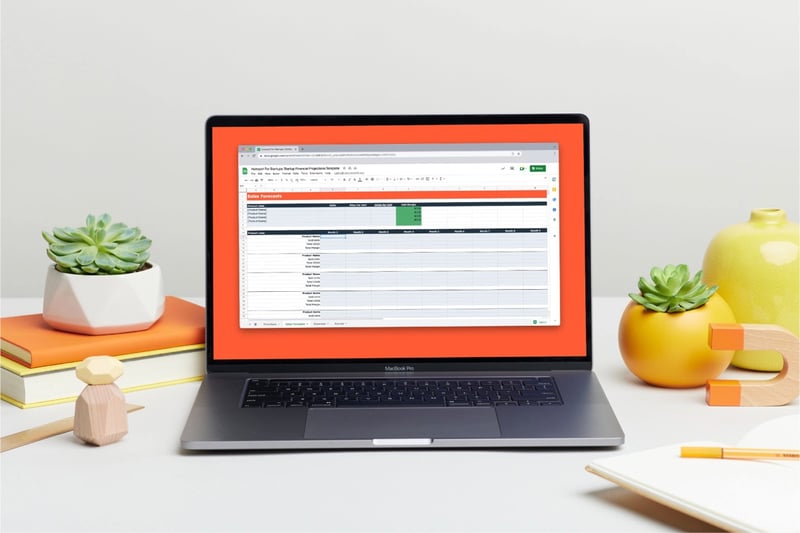
## How do you write a financial projection for a startup?
Financial projections consider a range of internal revenue and expense data to estimate sales volumes, profit, costs, and a variety of financial ratios. All of this information is typically broken into two sections:
- __Sales forecasts__: includes units sold, number of customers, and profit
- __Expense budget__: includes fixed and variable operating costs
Financial projections also use existing financial statements to support your estimated forecasts, including:
- Income stateme
- Cash flow document
- Balance sheet
Gathering your business’s financial data and statements is one of the first steps to preparing your complete financial projection. Next, you’ll import that information into your financial projection document or template.
This foundation will help you build the rest of your forecast, which includes:
- Startup expenses
- Sales forecasts
- Cash flow statements
- Operating expenses
- Income statements
- Balance sheet
- Break-even analysis
- Financial ratios
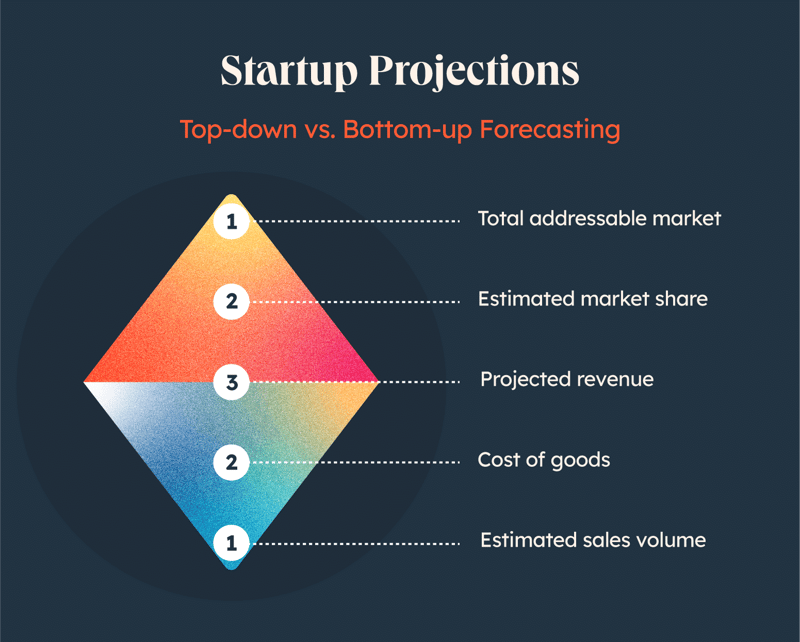
Once all of your data is gathered, you can organize your insights via a top-down or bottom-up forecasting methods.
The top-down approach begins with an overview of your market, then works into the details of your specific revenue. This can be especially valuable if you have a lot of industry data, or you’re a startup that doesn’t have existing sales to build from. However, this relies on a lot of averages and trends will be generalized.
Bottom-up forecasting begins with the details of your business and assumptions like your estimated sales and unit prices. You then use that foundation to determine your projected revenue. This process focuses on your business’s details across departments for more accurate reporting. However, mistakes early in forecasting can compound as you “build up.”
## 1. Startup expenses
If your startup is still in the seed stage or expected to grow significantly in the next few quarters, you’ll need to account for these additional expenses that companies beyond the expansion phase may not have to consider.
Depending on your startup stage, typical costs may include:
- Accounting
- Advertising and marketing
- Equipment
- Lawyer fees
- Licenses and permits
- Insurance
- Market research
- Merchandise
- Office space
- Payroll
- Utilities
- Website development
Many of these costs also fall under operating expenses, though as a startup, items like your office space lease may have additional costs to consider, like a down payment or renovation labor and materials.
## 2. Sales forecasts
Sales forecasts can be created using a number of different forecasting methods designed to determine how much an individual, team, or company will sell in a given amount of time.
This data is similar to your financial projections in that it helps your organization set targets, make informed business decisions, and identify new opportunities. A sales forecast report is just much more niche, using industry knowledge and historical sales data to determine your future sales. Gather data to include:
- Customer acquisition cost (CAC)
- Cost of goods sold (COGS)
- Sales quotas and attainment
- Pipeline coverage
- Customer relationship management (CRM) score
- Average Revenue Per User (ARPU), typically used for SaaS companies
Sales forecasts should consider interdepartmental trends and data, too. In addition to your sales process and historical details, connect with other teams to apply insights from:
- Marketing strategies for the forecast period
- New product launches
- Financial considerations and targets
- Employee needs and resources from HR
Your sales strategy and forecasts are directly tied to your financial success, so an accurate sales forecast is essential to creating an effective financial projection.
## 3. Operating expenses
Whereas the costs of goods solds (aka Cost of Sales or COGS) account for variable costs associated with producing the products or services you produce, operating expenses are the additional costs of running your startup, including everything from payroll and office rent to sales and marketing expenses.
In addition to these fixed costs, you’ll need to anticipate one-time costs, like replacing broken machinery or holiday bonuses. If you’ve been in business for a few years, you can take a look at previous years’ expenses to see what one-time costs you ran into, or estimate a percentage of your total expenses that contributed to variable costs.
## 4. Cash flow statements
Cash flow statements (CFS) compare a business’s incoming cash totals, including investments and operating profit, to their expected expenses, including operational costs and debt payments.
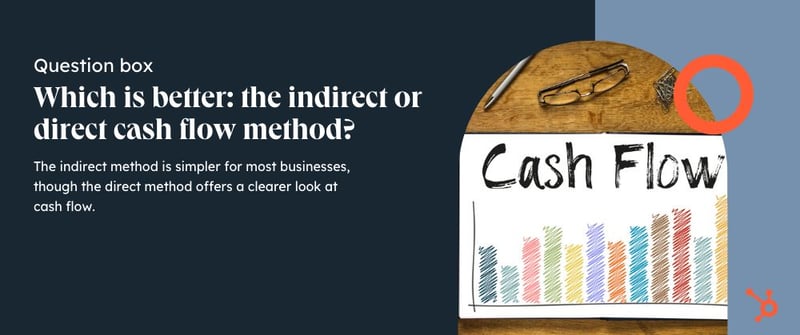
Cash flow shows a company’s overall money management and is one of three major financial statements, next to balance sheets and income statements. It can be calculated using one of two methods:
- __Direct Method__: calculates actual cash flow in and out of the company
- __Indirect Method__: adjusts net income considering non-cash revenue and expenses
Businesses can use either method to determine cash flow, though presentation differs slightly. Typically, indirect cash flow methods are preferred by accountants who largely use accrual [accounting methods](https://blog.hubspot.com/sales/accounting-101?missing=undefined).
## 5. Income statements
Your income statement projection utilizes your sales forecasts, estimated expenses, and existing income statements to calculate an expected net income for the future.
In addition to the hard numbers available, you should apply your industry expertise to consider new opportunities for your business to grow. If you’re entering Series C, you should anticipate the extra investments and big returns that you’re aiming to experience this round.
Once you’ve collected your insights, use your existing income statement to track your estimated revenue and expenses. Total each and subtract the expenses from the revenue projections to determine your projected income for the period.
## 6. Balance sheet
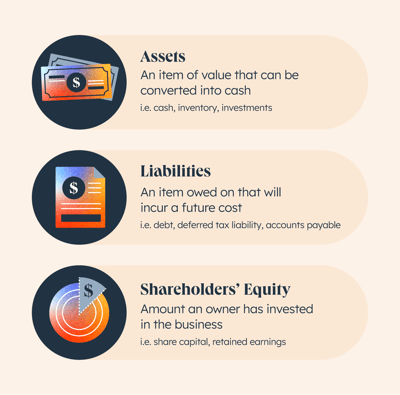
Your balance sheet is the final of the big three financial documents needed to establish your company’s financial standing. The balance sheet makes a case for your company’s financial health and future net worth using these details:
- Company’s assets
- Business’s liabilities
- Shareholders’ equity
This document breaks down the company’s owned assets vs. debt items. It most directly tracks earnings and spendings, and it also doubles as an actual to establish profitability for prospective investors.
## 7. Break-even analysis
Launching a startup or new product line requires a significant amount of capital upfront. But at some point, your new endeavor will generate a profit. A break-even analysis identifies the moment that your profit equals the exact amount of your initial investment, meaning you’ve broken even on the launch and you haven’t lost or gained money.
A break-even point (BEP) should be identified before launching your business to determine its viability. The higher your BEP, the more seed money you’ll need or the longer it will be until operations are self-sufficient.
Of course, you can also increase prices or reduce your production costs to lower the BEP.
As your business matures, you can use the BEP to weigh risks with your product decisions, like implementing a new product or removing an existing item from the mix.
## 8. Financial ratios
Financial ratios are common metrics that lenders use to check financial health using data from your financial statements. There are five core groups of financial ratios used to evaluate businesses, as well as an example of each:
Efficiency ratios: Analyze a company’s assets and liabilities to determine how efficiently it manages resources and its current performance.
Formula: Asset turnover ratio = net sales / average total assets
Leverage ratios: Measure a company’s debt levels compared to other financial metrics, like total assets or equity.
Formula: Debt ratio = total liabilities / total assets
Liquidity ratios: Compare a company’s liquid assets and its liabilities to lenders to determine its ability to repay debt.
Formula: Current ratio = current assets / current liabilities
Market value ratios: Determine a public company’s current stock share price.
Formula: Book value per share (BVPS) = (shareholder’s equity - preferred equity) / total outstanding shares
Profitability ratios: Utilize revenue, operating costs, equity, and other other balance sheet metrics to asses a company’s ability to generate profits.
Formula: Gross profit margin = revenue / COGS
Graphs and charts can provide visual representations of financial ratios, as well as other insights like revenue growth and cash flow. These assets provide an overview of the financial projections in one place for easy comparison and analysis.
## Startup Financial Projections Template
As a startup, you have some extra considerations to apply to your financial projections. Download and customize our financial projections template for startups to begin importing your financial data and build a road map for your investments and growth.
Get template
## Plan for future success with HubSpot for Startups
A sound financial forecast paves the way for your next moves and reassures investors (and yourself) that your business has a bright future ahead. Use our startup financial projections template to estimate your revenue, expenses, and net income for the next three to five years.
Ready to invest in a CRM to help you increase sales and connect with your customers? [HubSpot for Startups](https://www.hubspot.com/startups?missing=undefined) offers sales, marketing, and service software solutions that scale with your startup.
Back
Close
## Popular Features
- [All Products and Features All Products and Features](https://www.hubspot.com/products?missing=undefined)
- [HubSpot AEO HubSpot AEO](https://www.hubspot.com/products/aeo?missing=undefined)
- [Free Meeting Scheduler App Free Meeting Scheduler App](https://www.hubspot.com/products/sales/schedule-meeting?missing=undefined)
- [Agent Hub Agent Hub](https://www.hubspot.com/products/artificial-intelligence?missing=undefined)
- [Email Tracking Software Email Tracking Software](https://www.hubspot.com/products/sales/email-tracking?missing=undefined)
- [AI Content Writer AI Content Writer](https://www.hubspot.com/products/cms/ai-content-writer?missing=undefined)
- [AI Website Generator AI Website Generator](https://www.hubspot.com/products/cms/ai-website-generator?missing=undefined)
- [Email Marketing Software Email Marketing Software](https://www.hubspot.com/products/marketing/email?missing=undefined)
- [Lead Management Software Lead Management Software](https://www.hubspot.com/products/crm/lead-management?missing=undefined)
- [AI Prospecting Agent AI Prospecting Agent](https://www.hubspot.com/products/sales/ai-prospecting-agent?missing=undefined)
- [Free Website Builder Free Website Builder](https://www.hubspot.com/products/cms/drag-and-drop-website-builder?missing=undefined)
- [Landing Pages Landing Pages](https://www.hubspot.com/products/marketing/landing-pages?missing=undefined)
- [Free Online Form Builder Free Online Form Builder](https://www.hubspot.com/products/marketing/forms?missing=undefined)
- [Free Chatbot Builder Free Chatbot Builder](https://www.hubspot.com/products/crm/chatbot-builder?missing=undefined)
- [Free Live Chat Software Free Live Chat Software](https://www.hubspot.com/products/crm/live-chat?missing=undefined)
- [Marketing Analytics Marketing Analytics](https://www.hubspot.com/products/marketing/analytics?missing=undefined)
- [Free Landing Page Builder Free Landing Page Builder](https://www.hubspot.com/products/marketing/landing-pages?missing=undefined)
- [Free Web Hosting Free Web Hosting](https://www.hubspot.com/products/cms/web-hosting?missing=undefined)
## Free Tools
- [See All Free Business Tools See All Free Business Tools](https://www.hubspot.com/free-business-tools?missing=undefined)
- [AI Search Grader AI Search Grader](https://www.hubspot.com/ai-search-grader?missing=undefined)
- [AI Search Sensor AI Search Sensor](https://www.hubspot.com/aeo-sensor?missing=undefined)
- [Make My Persona Make My Persona](https://www.hubspot.com/make-my-persona?missing=undefined)
- [Email Signature Generator Email Signature Generator](https://www.hubspot.com/email-signature-generator?missing=undefined)
- [Free Business Templates Free Business Templates](https://www.hubspot.com/resources/templates?missing=undefined)
- [Software Comparisons Library Software Comparisons Library](https://www.hubspot.com/comparisons?missing=undefined)
- [Website Templates Website Templates](https://ecosystem.hubspot.com/marketplace/website?missing=undefined)
- [Connector for Claude Connector for Claude](https://www.hubspot.com/claude?missing=undefined)
## Company
- [About Us About Us](https://www.hubspot.com/our-story?missing=undefined)
- [Careers Careers](https://www.hubspot.com/careers?missing=undefined)
- [Management Team Management Team](https://www.hubspot.com/company/management?missing=undefined)
- [Board of Directors Board of Directors](https://www.hubspot.com/company/board-of-directors?missing=undefined)
- [Investor Relations Investor Relations](https://ir.hubspot.com/)
- [Blog Blog](https://blog.hubspot.com/)
- [Sustainability Sustainability](https://www.hubspot.com/sustainability?missing=undefined)
- [Contact Us Contact Us](https://www.hubspot.com/company/contact?missing=undefined)
## Customers
- [Customer Support Customer Support](https://help.hubspot.com/)
- [Join a Local User Group Join a Local User Group](https://www.hubspot.com/hubspot-user-groups?missing=undefined)
## Partners
- [All Partner Programs All Partner Programs](https://www.hubspot.com/partners?missing=undefined)
- [Solutions Partner Program Solutions Partner Program](https://www.hubspot.com/partners/solutions?missing=undefined)
- [Technology Partner Program Technology Partner Program](https://www.hubspot.com/partners/app?missing=undefined)
- [HubSpot for Startups HubSpot for Startups](https://www.hubspot.com/startups/partners?missing=undefined)
- [Affiliate Program Affiliate Program](https://www.hubspot.com/partners/affiliates?missing=undefined)
- [Facebook](https://www.facebook.com/hubspot?missing=undefined)
- [Instagram](https://www.instagram.com/hubspot/?missing=undefined)
- [Youtube](https://youtube.com/user/HubSpot?missing=undefined)
- [Twitter](https://x.com/HubSpot?missing=undefined)
- [Linkedin](https://www.linkedin.com/company/hubspot?missing=undefined)
- [Reddit](https://www.reddit.com/r/hubspot?missing=undefined)
- [Tiktok](https://www.tiktok.com/@hubspot?missing=undefined)
[](https://apps.apple.com/us/app/hubspot/id1107711722?missing=undefined) [](https://play.google.com/store/apps/details?missing=undefined)
[](https://www.hubspot.com/)
Copyright © 2026 HubSpot, Inc.
- [Legal Center](https://legal.hubspot.com/legal-center?missing=undefined)
- [Privacy Policy](https://legal.hubspot.com/privacy-policy?missing=undefined)
- [Security](https://legal.hubspot.com/security?missing=undefined)
- [Website Accessibility](https://legal.hubspot.com/website-accessibility?missing=undefined)
- [Manage Cookies](https://www.hubspot.com)
## Get the template
Close
### Get the template
Business Email*
First Name*
Last Name*
Primary role*
Please SelectStartup FounderStartup Team MemberVC/InvestorStartup Ecosystem ProfessionalEnterprise Leader (Director+)Enterprise EmployeeAgency, Consultant, or Service ProviderOtherCreator or Media
Content Language
reCAPTCHA score
GACLIENTIDAnonymously identifies a browser instance. This is a non-authenticated, cookie-based identifier created automatically by a Analytics-enabled site on a user’s first visit. Identifying users with Client ID is best suited for businesses focused on lead generation and new customers acquisition. Added to join our customer data to google data at the request of MOps on 12/19/18 (See BIZREQ-11194).
\[DO NOT USE] GAUSERIDEnables the analysis of groups of sessions, across devices, using a unique, persistent, and non-personally identifiable ID string representing a user. Added to join our customer data to google data at the request of MOps on 12/19/18 (See BIZREQ-11194).
GATRACKIDThe google tracking ID. Added to join our customer data to google data at the request of MOps on 12/19/18 (See BIZREQ-11194).
We're committed to your privacy. HubSpot uses the information you provide to us to contact you about our relevant content, products, and services. You may unsubscribe from these communications at any time. For more information, check out our [Privacy Policy](https://legal.hubspot.com/privacy-policy).