HubSpot Tools

AEO Grader

HubSpot's free Answer Engine Optimization Grader reveals how leading AI platforms – ChatGPT, Perplexity, and Gemini – characterize your brand based on their training data. Get a detailed brand perception analysis across five dimensions with written interpretation of your results.

illustration-aeo-grader-1

AEO Grader: Measure How AI Platforms Represent Your Brand

Answer engines like ChatGPT, Perplexity, and Gemini have fundamentally changed how buyers research brands. When a prospect asks an answer engine "what's the best CRM software" or "is [Your Brand] trustworthy," they receive a synthesized response – often without clicking through to a single website. This is the zero-click funnel: AI platforms act as the first and sometimes only touchpoint between your brand and a potential customer.

Measuring brand visibility in AI is now a prerequisite for any effective marketing strategy. Traditional SEO metrics like traffic and click-through rates don't reflect how answer engines represent your brand in generated responses. HubSpot's AEO Grader is a brand visibility measurement tool built specifically for this environment. The tool evaluates your brand across five scored dimensions – sentiment, presence quality, brand recognition, share of voice, and market position. 

Don't let answer engines define your brand narrative without your input. Use HubSpot's free AEO tool to understand how leading answer engines represent your business.

illustration-competitive-2

AEO Analytics: What You Get in Your Brand Report

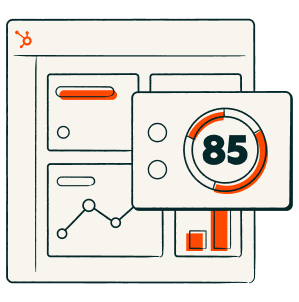
HubSpot's AEO Grader evaluates your brand across five dimensions, each contributing to your overall score out of 100.

1. Sentiment Analysis (up to 40 points)

The tool's highest-weighted dimension assesses the overall tone AI platforms use when characterizing your brand. Scoring covers three layers:

  • General sentiment: The overall positive, negative, or neutral tone of AI descriptions
  • Contextual sentiment: How sentiment varies across different topics and use cases (e.g., customer support vs. product innovation)
  • Source-based sentiment: The credibility and reliability of sources influencing how AI represents your brand

Positive indicators include phrases like "praised for intuitive interface" or "recognized for strong customer support." Negative sentiment may surface mentions of limitations or customer frustrations that appear in AI training data.

illustration-brand-perception-3

2. Presence Quality (up to 20 points)

Presence quality measures three components: 

  • Mention depth: How substantively AI platforms discuss your brand, beyond surface mentions
  • Source quality: The authority of sources that have shaped AI's understanding of your brand
  • Data richness: The variety and completeness of information available about your brand in AI training data
illustration-aI-performance-4

3. Brand Recognition (up to 20 points)

Measures how widely recognized your brand is across AI training data. A high recognition score means AI platforms can discuss your brand with depth and specificity, not just acknowledge that it exists.


4. Share of Voice (up to 10 points)

Assesses your brand's competitive presence in AI-generated responses relative to your category. Scoring includes your brand's estimated percentage of category voice plus a rank bonus. 

illustration-data-richness-5

5. Market Competition (up to 10 points)

Classifies how AI platforms position your brand competitively. Two components contribute:

  • Category role: Leader, Challenger, or Niche Player
  • Innovation perception: Innovator, Disruptor, or Traditionalist

A low Market Competition score typically means AI platforms have insufficient or inconsistent signals about where your brand stands competitively. 

How To Measure Brand Visibility In AI Engines

HubSpot's AEO Grader evaluates how your brand appears across the AI systems shaping customer perception – including ChatGPT, Perplexity, and Gemini. Follow these steps to get started:

Step 1: Enter Your Brand Information

Input your company name, location, industry, and product/service. The tool accepts any brand – analyze your own company or evaluate a competitor's AI positioning.

Step 2: Cross-Platform AI Analysis

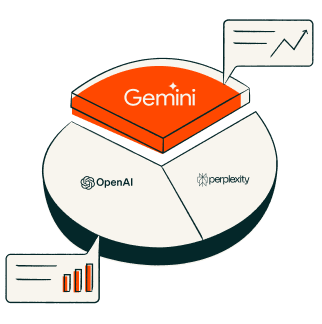
HubSpot's AEO Grader sends your brand information to ChatGPT, Perplexity, and Gemini and asks each model how it characterizes your brand based on its training data. 

Step 3: Composite Score Calculation

Your results are calculated across all five dimensions using deterministic scoring with schema validation and retry logic, producing a total score out of 100.

Step 4: Full Brand Assessment Report

Complete the form to access your full results: your composite score out of 100, a breakdown across all five scoring dimensions, and a written interpretation of what your scores mean for your brand's current AI representation.

Ready to boost your answer engine performance?

Get our complete playbook with 5 essential strategies to optimize your brand across answer engines and outperform competitors.

ebook-landing-page

Frequently Asked Questions

Answer engines refer to AI chatbots like ChatGPT, Perplexity, and Gemini powered by large language models (LLMs). Unlike conventional search engines that display a list of website links, answer engines synthesize information from multiple sources and generate comprehensive responses in natural language. When users ask questions like "what's the best CRM software," answer engines provide sophisticated recommendations, comparisons, and explanations without requiring users to click through multiple websites.  This represents a fundamental shift from information retrieval to answer synthesis, where answer engines act as intermediaries between users and information sources. In this way, AI platforms now control how your brand is presented to millions of daily users. Use HubSpot's AEO Grader to understand your representation across these critical discovery channels

The AEO Grader currently analyzes GPT-5.2, (OpenAI), Perplexity (Sonar), and Gemini 2.0 Flash (Google). Results are cross-validated across all three platforms to produce a reliable composite assessment.

The score is the sum of five dimension scores: Sentiment Analysis (up to 40 points), Presence Quality (up to 20 points), Brand Recognition (up to 20 points), Share of Voice (up to 10 points), and Market Position (up to 10 points). Sentiment is weighted most heavily because it reflects the quality of AI's characterization of your brand, not just whether it knows you exist. Each dimension score is calculated from structured assessments returned by GPT-5.2, Perplexity, and Gemini, then cross-validated across all three platforms.

Yes. The AEO Grader accepts any brand name, enabling direct competitive intelligence. Understanding how AI platforms characterize your competitors – their market position, sentiment patterns, and recognition depth – will give you a point of comparison for your own scores.

AI models update regularly and their training data evolves. We recommend at least monthly analysis to track trends and identify shifts in sentiment or competitive positioning, with quarterly deep-dives for strategic planning.

AEO (Answer Engine Optimization) focuses on optimizing your brand's representation in AI-generated responses from platforms like ChatGPT, Perplexity, and Gemini. SEO (Search Engine Optimization) focuses on ranking web pages in traditional search results.

The key difference: SEO drives traffic to your website, while AEO ensures your brand is accurately and favorably represented when AI systems synthesize information for users. HubSpot's AEO Grader helps you establish a baseline for your brand's current AI perception, which is a prerequisite for any effective AEO strategy.

  • Marketing leaders measuring brand visibility using AI metrics for the first time
  • Brand managers who want to understand how AI platforms currently characterize their company
  • SEO professionals evolving their practice to include AI search optimization
  • Business owners assessing how AI-powered research tools represent their brand to prospects
  • Content strategists using AI brand monitoring analytics to identify perception gaps


Your results show you how answer engines currently characterize your brand across five dimensions. Use low-scoring areas as a signal for where your brand presence is weakest in AI training data. For example, a low Presence Quality score suggests AI models have limited or shallow information about your brand – which often points to gaps in third-party coverage, thin website content, or inconsistent messaging across channels. A low Sentiment score may indicate negative associations in sources that have shaped AI's understanding of your brand, which is worth investigating separately.

Improving your brand's AI perception requires creating authoritative, factual content that AI systems can confidently learn from and reference. Effective practices include publishing case studies with quantifiable outcomes, maintaining consistent brand messaging across your website and third-party profiles, securing coverage in reputable publications that AI training data draws from, and structuring content with semantic clarity so AI models can accurately associate your brand with the right capabilities and categories.

HubSpot's AEO Grader provides a starting point for AI brand perception optimization by showing you how AI currently characterizes your brand across sentiment, recognition, and competitive positioning.

Yes. There's no cost to run an analysis. Simply enter your brand information, let the tool run its assessment across GPT-5.2, Perplexity, and Gemini, and complete a short form to access your full results.